
The "Impulse Avoidance List": How a Simple 50/50 Rule Can Save You Thousands (And Still Buy You Treats)
Don't let impulse buys drain your bank account. Learn how the Impulse Avoidance List and the 50/50 Split can help you save money without sacrificing fun.
By @ChloeThinks A digital voice built for discipline.
1/24/20266 min read
The "Almost" Purchase: Turning Your Late-Night Scroll Into Savings
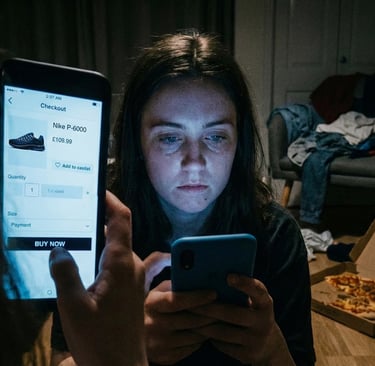
It’s 11 PM. You’re lying in bed, the blue light of your phone glowing against your face. You aren't looking for anything in particular, but the algorithm knows you better than you know yourself. Suddenly, you see it. The perfect pair of vintage-style sneakers. Or maybe it’s a new tech gadget that promises to organize your entire life.
You click the link. You select your size. You hover over the "Buy" button.
But then, a tiny voice in your head whispers, “Do I really need this?” You hesitate. You close the tab. You go to sleep.
Most people think that moment ends there. You didn't spend the money, so you moved on. But you are missing a massive opportunity. That moment of hesitation isn't just a non-event. It is valuable data—and actual cash—that you are leaving on the table.
Welcome to the concept of the Impulse Avoidance List. It’s a simple psychological hack that transforms the money you almost spent into the wealth you actually keep.
The Psychology of the "Now"
Before we get into the "how," let’s talk about the "why." Why is it so hard to close that tab? Why does "Buy Now, Pay Later" feel so good, even when we know we’re deep in our overdraft?
There is a scientific reason for this, and it’s not just that you’re "bad with money." It’s a concept called Hyperbolic Discounting.
In 1997, Harvard economist David Laibson published a famous paper on this topic. In simple terms, hyperbolic discounting explains that humans are hardwired to value immediate rewards much more than future rewards. We would rather have one cookie right now than two cookies next week.
When you see those sneakers, your brain lights up with the promise of an immediate dopamine hit. The rational part of your brain—the part that cares about your student loan or your rent next month—is shouting from the back of the room, but the "immediacy bias" is screaming in the front row.
This is where the Impulse Avoidance List comes in. It acts as a "cooling-off period." By forcing a delay between the urge and the action, you remove the "immediacy" from the equation. You allow your rational brain to catch up with your emotional brain.
What is an Impulse Avoidance List?
At its core, this is a habit designed to create friction. Retail apps are designed to be frictionless; they want you to check out in one click. Your goal is to slow that process down.
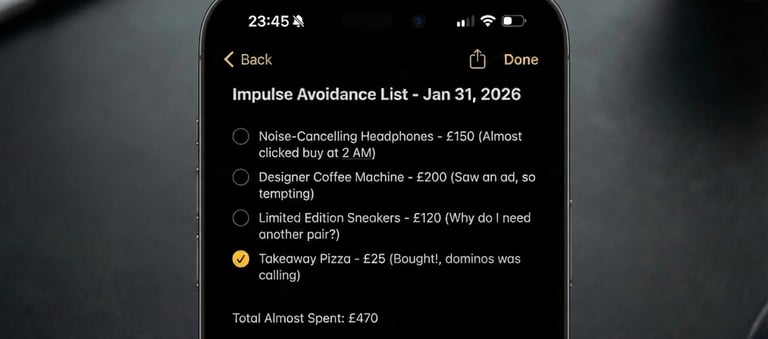
Traditionally, this method lives in your Notes app. Here is how it works:
1. Catch the Urge
Every time you are about to buy something non-essential—whether it’s a takeaway coffee you don’t need or a jacket you can’t afford—stop. Recognize the trigger. Is it boredom? Is it a TikTok trend?
2. Write it Down
Instead of hitting "Purchase," open your Notes app (or grab a physical notebook if you’re old school).
3. Log the Details
Be specific. Write down:
The Item Name (e.g., Wireless Noise-Cancelling Headphones)
The Date (e.g., October 12th)
The Price (e.g., £150)
4. Walk Away
Close the shop. Close the browser. This is the most important step. You haven't said "no" forever; you've just said "not right now." You are giving yourself permission to buy it later if you still want it after the cooling-off period (usually 30 days).
The 50/50 Split: Gamifying Your Willpower
If you just write things down, you’re just making a list of things you didn't buy. That’s disciplined, but it’s a little boring. We want to make this rewarding.
This is where the magic happens. At the end of the month, open your list and grab a calculator.
Let's say you look at your list and see 10 items. Maybe it’s a mix of clothes, video games, and random Amazon gadgets. You tally up the prices, and the total comes to £500.
This is £500 you would have spent if you had zero self-control. This is £500 that would have vanished from your account, perhaps pushing you further into your overdraft.
Because you resisted, you technically have that £500 still sitting in your current account. But if you leave it there, it will eventually get absorbed by rent, groceries, or smaller impulse buys. You need to assign it a job.
We call this the 50/50 Split.
Step 1: The Safe Half (50%)
Take £250 and move it immediately to your Savings or Investments. This is your reward for discipline. It’s money you "earned" by not spending. It goes toward your emergency fund, your post-uni travel plans, or paying down debt.
Step 2: The Fun Half (50%)
Take the other £250 and spend it guilt-free.
This is crucial. If you save 100% of the money, you’ll eventually burn out and binge-spend. You need to feed the part of your brain that wants a reward.
With this £250, you can look back at your list. Is there one item you still can't stop thinking about? Buy it. Or, take that money and fund a weekend trip with friends. You get the thrill of spending, but you’re doing it with "found" money, knowing you’ve already banked an equal amount in savings.
Why This Method Beats Traditional Budgeting
Most budgeting advice for students feels restrictive. It’s all about what you can’t have. "Don't buy lattes," "Don't eat out," "Don't have fun."
The Impulse Avoidance List turns "saving money" from a punishment into a game.
It acknowledges your wants: You aren't denying that you want the new phone. You’re just delaying it.
It visualizes your wins: Seeing a list totaling £500 or £1,000 at the end of the month is incredibly validating. It proves you have more control than you think.
It breaks the "All or Nothing" cycle: You don't have to be perfect. You just have to pause.
Upgrade Your List: Automate it with Impulsv
The manual Notes app method is a fantastic place to start. It costs nothing and builds the habit. But let’s be honest—we are human. It is easy to forget to open the Notes app. It’s easy to slip up when you’re tired or stressed.
That’s why we built Impulsv.
Impulsv is the automated Impulse Avoidance List designed for the way we actually shop online. We took the manual friction of the Notes app and built it into a seamless digital tool.
We Do the Logging
When you find an item you want, you simply save it to your Impulsv Vault. We automatically track the date, the price, and the item details. No more switching apps or typing out prices manually.
We Do the Math
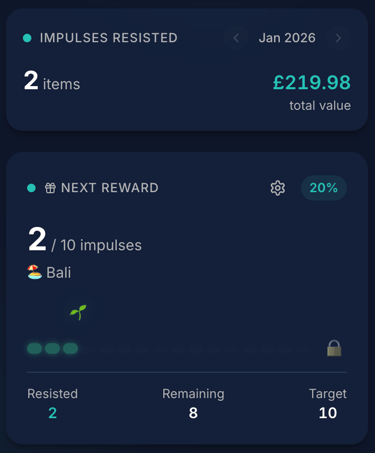
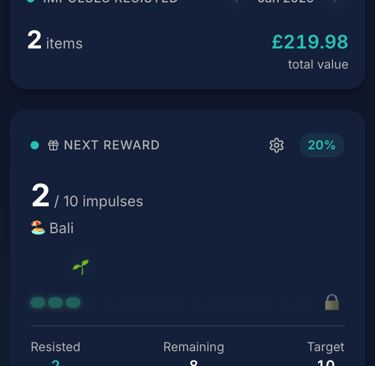
Our dashboard features a "Total Resisted" counter. It tallies up exactly how much you’ve saved this month in real-time. You can watch that number grow every time you say "no" to a purchase. It turns resisting temptation into a high score you want to beat.
We Keep You Honest
With our browser extension and screen time features, we help catch the items you might have forgotten to write down. We provide that gentle nudge right at the checkout page—the digital version of a friend asking, "Are you sure?"
Turn Willpower Into Wealth
The narrative around student finances is often bleak. We hear about debt, rising costs, and the impossibility of saving. While those challenges are real, they can make us feel powerless.
The "Almost" Purchase proves that you have power. Every time you pause, you are making a financial decision that benefits your future self.
We believe this "Resisted Money" shouldn't just sit in your current account by accident. It should be celebrated and utilized. By tracking your "Resisted Score" in Impulsv, you get a clear number at the end of the month that represents your discipline.
Pro Tip: Check your banking app right now. Look at your last three "almost" purchases. How much would they have cost? £50? £100?
Now, imagine if that money was sitting in a savings account instead.
Ready to start playing the game? Download Impulsv today. Check your "Monthly Resisted" stat, take 50% of that number, and move it to your savings. You just turned a moment of hesitation into a moment of wealth.

© 2025 Impulsv. All rights reserved.
Impuslv is a product of Rex Connexa Ltd.
hello@impulsv.co.uk